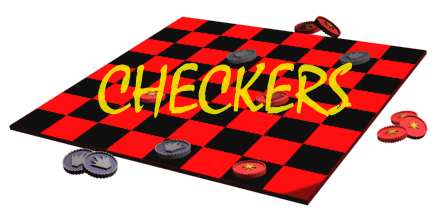
Checkers was first played sometime in the 12th century. "Draughts", as it is known in Europe, is said to have been created in France or Spain, where books on how to play were published as early as the mid-1500s. There are many derivations of draughts, even versions using ten by ten inch boards. The most popular version is the one known as checkers, which uses an English, or standard, board of eight squares by eight squares. This version of checkers uses a Standard English 64-square board.
To begin a new game, select "new game" from the "file" menu. Enter the requested information and click OK to
begin the new game.
Each player begins the game with twelve single playing pieces. During the game a single playing piece becomes
a "king" when it has successfully reached the opponent's back or starting row.
The object of checkers is to capture all
your opponent's pieces, or to prevent your opponent from being able to move any of their pieces. Red playing pieces
are assigned to one player at random and white to the other; the red player always goes first.
Play occurs on the dark squares of the board only. Players will alternate moves as described in the following sections. Only one playing piece may be moved per turn.
Single piece movement:
Single pieces may only move diagonally forward towards the opponent's back row. A single playing piece is automatically made a king when it has reached the opponent's back row. A move may be made to a diagonally adjacent open square. If a jump is present, it must be taken.
King movement:
Kings may move diagonally forward and backward to a diagonally adjacent open square. Kings move one square at a time, and must also take jumps when they are present.
An opponent's playing piece is captured by "jumping" over an adjacent opponent's piece into a vacant square.
Once a piece has been jumped, it is removed from the board. Both types of pieces (single and king) are eligible to be
captured by either playing piece. Multiple jumps may only be made in one direction with a single piece, while a king
is allowed to make multiple jumps in both directions.
You must jump and capture an opponent's piece when the opportunity arises.
You will not be allowed to make another move until you make a capture when it is available to you. If you can
continue to jump and make multiple captures, you must do so and take all the pieces. If multiple jump opportunities
exist, the player may select the jump of their choice. If by result of a jump, a single playing piece lands in the opponents
back row, it automatically becomes a king and that player's turn is ended. A piece that has just become a king cannot
continue jumping pieces until the next move.
In standard checkers a player must complete a move within a designated time limit. If he fails to move before the time limit expires, an additional amount of time is granted to complete a move. If a move is not made before the additional time limit expires, the player forfeits the game due to improper delay. The standard limit for a timed move is five minutes and one minute for the additional timer, but other values may be entered when configuring a new game.
A game is concluded in one of the following manners:
To configure a network game, one player must be a host, and another must be a client. The client node must know the IP address of the host node. Once a new game is started, the client will attempt to connect to the host, and the host will acknowledge or deny the connection.